

Reviewed: 10 July 2026 · Author: Sergey Zlobin, CEO of Maketto
Quick answer. From Japan, EMS reaches the US and most of Europe in roughly 3–7 days including customs, express couriers (DHL/FedEx/UPS) in 1–5 business days, airmail parcels in 1–2 weeks, and sea mail in 1–3 months. Cost depends on weight and destination zone: a 1 kg EMS parcel is ¥5 300 to the US and ¥4 400 to Europe (official Japan Post rates as of 1 January 2026).
Shipping methods from Japan
Every parcel leaving Japan travels one of two main ways: Japan Post or an international courier. Japan Post is the default for personal parcels — cheaper, with several speed tiers. Couriers are faster and pricier.
| Method | Speed (guideline) | Price level | Notes, July 2026 |
|---|---|---|---|
| Japan Post EMS | 2–4 days in transit + customs | highest among postal | up to 30 kg; priority handling, full tracking |
| Japan Post airmail parcel | 3–6 days in transit + customs | below EMS | solid mid-option |
| Japan Post small packet (air) | about 1–2 weeks | cheapest air for ≤2 kg | limited tracking |
| Japan Post SAL (economy air) | 6–13 days on paper | between air and sea | suspended to most destinations since the pandemic — many guides still list it, but it is effectively unavailable |
| Japan Post surface (sea) | 1–3 months | cheapest overall | tracking pauses while the ship is at sea |
| DHL / FedEx / UPS | 1–5 business days door-to-door | roughly twice EMS for light parcels | up to 70 kg (DHL); best for urgent or heavy-dense boxes |
Data as of 10.07.2026. Sources: Japan Post shipping-type comparison and service-availability chart (updated 26.06.2026); carrier pages.
One 2026-specific note: Japan Post temporarily held US-bound mail early in the year and resumed acceptance on 13 April 2026, with some item-level restrictions still marked on the availability chart — worth knowing if a US parcel moves slower than the table suggests.
How long does delivery take by region?
Japan Post publishes average EMS delivery days from Tokyo: Singapore — 2 days, Germany and the UK — 5, France and Canada — 6, and the US typically 3–5 business days. Add customs clearance on top; that is what usually stretches real-world delivery to about a week for the US and Europe.
| Destination | EMS | Airmail parcel | Sea mail | Courier (DHL/FedEx/UPS) |
|---|---|---|---|---|
| USA | ~3–7 days | 1–2 weeks | 1–3 months | 1–3 business days |
| Europe (DE/FR/UK) | ~5–10 days | 1–2 weeks | 1–3 months | 1–3 business days |
| Asia (SG/TW/HK) | ~2–5 days | about a week | 1–2 months | 1–2 business days |
Ranges, not promises: EMS figures are Japan Post's published averages plus customs; courier figures are the carriers' published transit times for major cities. Data as of 10.07.2026.
How much does shipping cost?
Japan Post charges by weight bands and five destination zones. The official rate schedule effective 1 January 2026:
| Weight | Zone 1 (CN/KR/TW) | Zone 2 (rest of Asia) | Zone 3 (Europe, Oceania, Canada) | Zone 4 (USA) |
|---|---|---|---|---|
| 500 g | ¥1 450 | ¥1 900 | ¥3 150 | ¥3 900 |
| 1 kg | ¥2 200 | ¥3 150 | ¥4 400 | ¥5 300 |
| 2 kg | ¥3 400 | ¥4 550 | ¥6 700 | ¥7 900 |
| 5 kg | ¥6 400 | ¥8 150 | ¥13 000 | ¥15 100 |
EMS rates, official, as of 01.01.2026. Source: Japan Post rate schedule.
Cheaper tiers exist for non-urgent parcels. An airmail parcel to Europe: 1 kg — ¥3 850, 5 kg — ¥12 450; to the US: 1 kg — ¥4 200, 5 kg — ¥14 200. Sea mail is the budget champion for heavy boxes: 5 kg to Europe — ¥4 900 and to the US — ¥5 400, versus ¥13 000–15 100 by EMS — roughly a third of the price for those willing to wait 1–3 months. Couriers sit at the other end: for a light parcel expect roughly double the EMS price, in exchange for 1–3 day delivery and door-to-door handling.
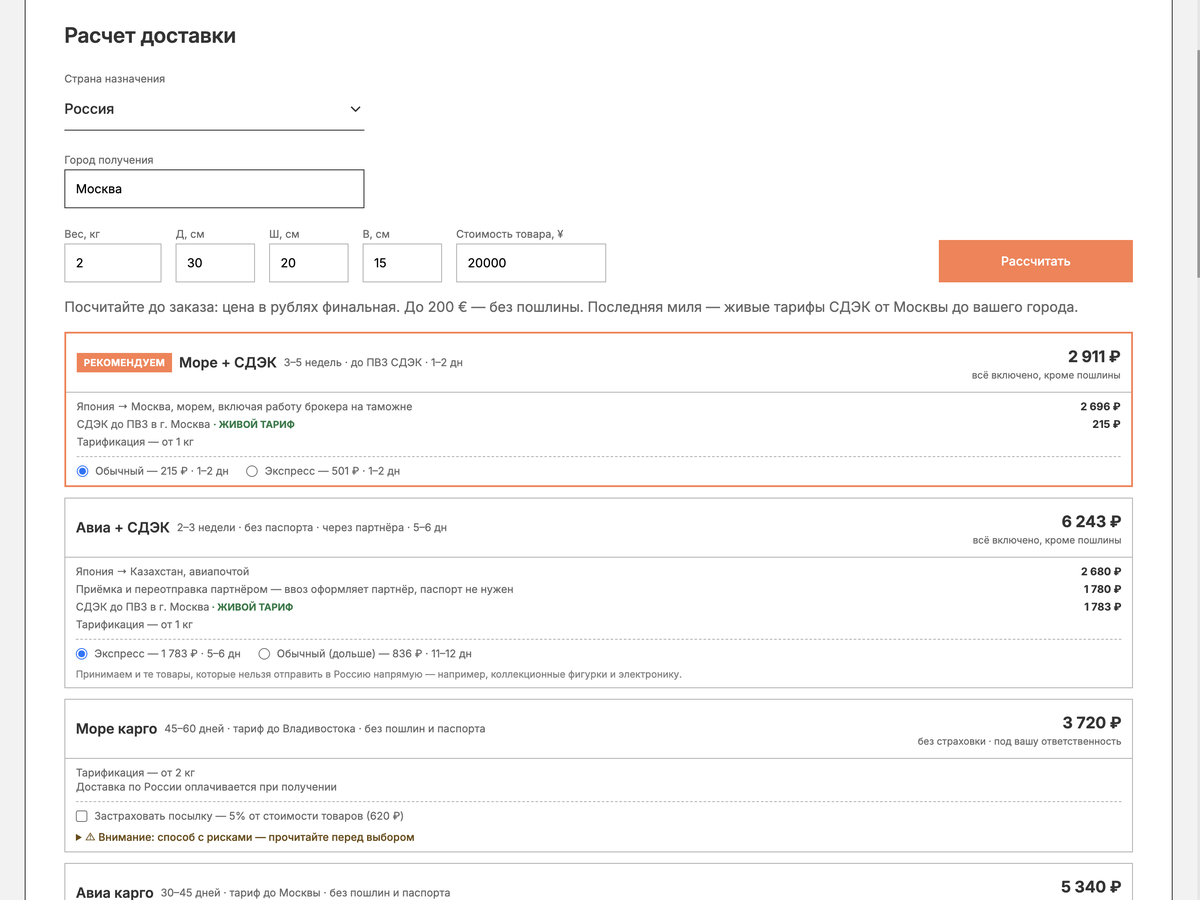
So the total is driven by three things: weight, zone, and how fast you need it. That is also why no service — us, Buyee or ZenMarket alike — can quote the exact final total before the item exists as a weighed, packed box. What you can do is estimate: the calculator on the maketto.jp homepage takes a weight and a country and shows the shipping estimate up front; the item price and service fee are visible from the start, and the exact shipping cost is set once the parcel is weighed at the warehouse.
Actual weight vs volumetric weight: which will you pay for?
For couriers, whichever is greater. Air freight sells space, not just kilograms, so a big light box is billed by volumetric weight:
Volumetric weight (kg) = length × width × height (cm) ÷ 5 000
Example: a 40 × 30 × 20 cm box is 24 000 cm³ — 4.8 kg volumetric. If the anime figure inside weighs 1 kg, a courier bills it as 4.8 kg. The divisor 5 000 is DHL's official formula and the express-industry standard (FedEx and UPS use the equivalent). Japan Post's counter services — EMS and international parcels — charge by actual weight within size limits, which is why the post office often beats couriers for bulky-but-light items, while couriers can win on small, dense, heavy boxes.
How consolidation and repacking save money
These are the two levers you actually control.
Consolidation means combining several orders into one international parcel. Every tariff has a fixed "first parcel" cost baked in, and you want to pay it once. On official EMS rates to the US: two separate 1 kg parcels cost 2 × ¥5 300 = ¥10 600, one combined 2 kg parcel costs ¥7 900 — a saving of ¥2 700, about 25%. The same logic holds for Europe (¥8 800 vs ¥6 700) and grows with every extra order you add to the box.
Repacking attacks volumetric weight. Japanese retailers ship in generous branded boxes, and the courier bills the box, not the item. Removing outer retail packaging and repacking compactly cuts volumetric weight — and the bill. Fragile items still get proper protective packing; the goal is a sensible balance, not the smallest possible box.
At Maketto, your orders accumulate at our warehouse in Toyama, get checked, photographed and repacked into one parcel — consolidation is part of the service, not a paid extra.
This is where Maketto does the work for you. Your orders collect at the Toyama warehouse, where they are checked, photographed and consolidated into one parcel — the main lever against both the fixed "first parcel" cost and volumetric weight, and part of the service rather than a paid extra. The item price and our 10% fee (¥1 000 minimum, covering the whole service from purchase to arranging shipping) are visible up front; estimate shipping on the shipping calculator on maketto.jp by weight and country, and the exact cost is confirmed after weighing. A manager can advise on the best method for a specific box.
FAQ
What is the cheapest way to ship from Japan? Sea mail: 5 kg to the US for ¥5 400 versus ¥15 100 by EMS (rates as of 01.01.2026). The trade-off is 1–3 months of transit and tracking gaps at sea.
What is the fastest way? Express couriers — DHL, FedEx, UPS deliver to major US, European and Asian cities in 1–3 business days. EMS is the fastest postal option at roughly 2–4 days in transit plus customs.
Is SAL still available? Effectively no. SAL remains on rate cards, but Japan Post's availability chart (updated 26.06.2026) shows it suspended to almost all destinations. Plan around EMS, airmail or sea.
Can I know the exact total before paying? The item price and service fee — yes, immediately. Exact shipping — only after the parcel is weighed at the warehouse, because the packed weight isn't known in advance. Use the homepage calculator (weight + country) for a solid estimate first.
Why did my light parcel cost so much? Volumetric weight: couriers bill length × width × height ÷ 5 000 if that exceeds actual weight. A large box with one small figure inside pays for its volume. Consolidating items into one well-packed box dilutes this effect.
Does consolidation really save money? Yes, typically 20–40%. Two 1 kg EMS parcels to the US cost ¥10 600 separately versus ¥7 900 combined into one 2 kg box — official rates, saving ¥2 700.
Key takeaways
- Delivery from Japan in 2026: couriers 1–5 business days, EMS about 3–7 days to the US/Europe with customs, airmail 1–2 weeks, sea mail 1–3 months. Ranges, not guarantees.
- Cost is set by weight band and zone: 1 kg EMS — ¥2 200 within East Asia, ¥4 400 to Europe, ¥5 300 to the US (official rates as of 01.01.2026).
- Couriers charge the greater of actual and volumetric weight (L × W × H ÷ 5 000); Japan Post charges actual weight within size limits.
- Consolidating several orders into one parcel saves 20–40%; compact repacking cuts volumetric weight further.
- SAL is suspended to most destinations, and US-bound mail carries some 2026 restrictions — check current status rather than old guides.
Sources
- Japan Post — International Mail Rate Schedule "As of January 1, 2026" (official rate PDF): post.japanpost.jp/assets/docs/service/send/oversea/charges_en.pdf. Checked 10.07.2026.
- Japan Post — EMS rate schedule, all zones: post.japanpost.jp/int/charge/list/ems_all_en.html. Checked 10.07.2026.
- Japan Post — List of Delivery Days, EMS from Tokyo: post.japanpost.jp/int/deli_days/ems/tokyo_en.html. Checked 10.07.2026.
- Japan Post — Comparing respective shipping types (EMS / airmail / SAL / surface time guidelines): post.japanpost.jp/int/service/dispatch/index_en.html. Checked 10.07.2026.
- Japan Post — international mail service availability by country, updated 26.06.2026 (SAL suspensions, US restrictions): post.japanpost.jp/int/information/overview_en.html. Checked 10.07.2026.
- Japan Post — International Parcel Post rate schedules, Third Zone (Europe) and Fourth Zone (USA): post.japanpost.jp/int/charge/list/parcel3_en.html, post.japanpost.jp/int/charge/list/parcel4_en.html. Checked 10.07.2026.
- DHL — What is Volumetric Weight (formula L × W × H ÷ 5 000, greater weight billed): dhl.com/discover/en-sg/ship-with-dhl/start-shipping/how-to-calculate-dhl-volumetric-weight. Checked 10.07.2026.
Update history
- 2026-07-10 — article published.