

Checked: 2026-11-16 · Author: Maketto Team

On 8 December 2016 Uniqlo presented a new kind of thermal underwear in Tokyo. On stage with a senior Fast Retailing executive was Jiro Tabata of Toray, the fibre maker that had co-developed HEATTECH since the first version in 2003. He explained why a third, warmest level was needed. By then HEATTECH was selling worldwide, Russia and Canada included, and Uniqlo had to think about severe cold and about people who spend long hours outdoors. The answer was Ultra Warm. Korea got it first, on 17 October; Japanese stores only had it from 19 December.
Since then HEATTECH in Japan has come in three levels: regular, Extra Warm and Ultra Warm. On Japanese labels and product pages the level is written in Japanese, so the three names are worth recognising on sight.
The short answer
| Level | On the label | Warmer than regular | Uniqlo's recommended range | Long-sleeve top |
|---|---|---|---|---|
| Regular | ヒートテック | — | 5 to 20 °C (41 to 68 °F) | ¥1,290 |
| Extra Warm | 極暖 | about 1.5× | −5 to 15 °C (23 to 59 °F) | ¥2,490 |
| Ultra Warm | 超極暖 | about 2.25× | −20 to 10 °C (−4 to 50 °F) | ¥2,990 |
Prices are for the basic crew-neck top. Uniqlo calls it a "T", but the sleeves are long, so check the sleeve length on the product page. Every model at all three levels for women, men and kids is listed with its price at the end of this article.
Uniqlo gives these ranges for underwear worn under other clothes and adds that everyone feels cold differently. Ultra Warm tops out at 10 °C (50 °F). That matters if you live somewhere with strong central heating: for a day spent mostly in an office, on a bus or in a mall, Extra Warm is the easier choice, because Ultra Warm can get too hot indoors. Ultra Warm is for long walks, outdoor work, ice fishing and days out of town.
Where the warmth comes from
HEATTECH works in two ways. Your body gives off moisture all the time, even when you're not sweating. The fibres absorb that vapour and release heat as they do. The second part is air: the yarn is built to hold warm air against the skin, and the more air pockets the fabric has, the warmer it is.
That is what separates the levels. In 2013 Uniqlo added more air pockets to the fabric, brushed the inside and got Extra Warm. For Ultra Warm the knit changed: the fibre became loftier, the brushed pile longer, and the four fibres — rayon, acrylic, polyester and elastane — went into a different mix.
The "1.5×" and "2.25×" figures come from lab measurement. Uniqlo compares CLO, a garment's thermal resistance, using the American test method ASTM D 1518-85. That doesn't convert into degrees: "twice as warm" doesn't mean it handles twice the frost. The 2016 press release also has a figure you won't find on product pages: compared with Extra Warm, men's Ultra Warm is 1.4 times warmer and women's 1.6 times.
How the fabrics differ
| Men's long-sleeve top | Composition (Japanese product page) |
|---|---|
| Regular | polyester 40%, acrylic 32%, rayon 21%, elastane 7% |
| Extra Warm, cotton | cotton 64%, acrylic 28%, elastane 8% |
| Extra Warm, cashmere blend | acrylic 57%, rayon 28%, cashmere 9%, elastane 6% |
| Ultra Warm | polyester 35%, acrylic 34%, rayon 23%, elastane 8% |
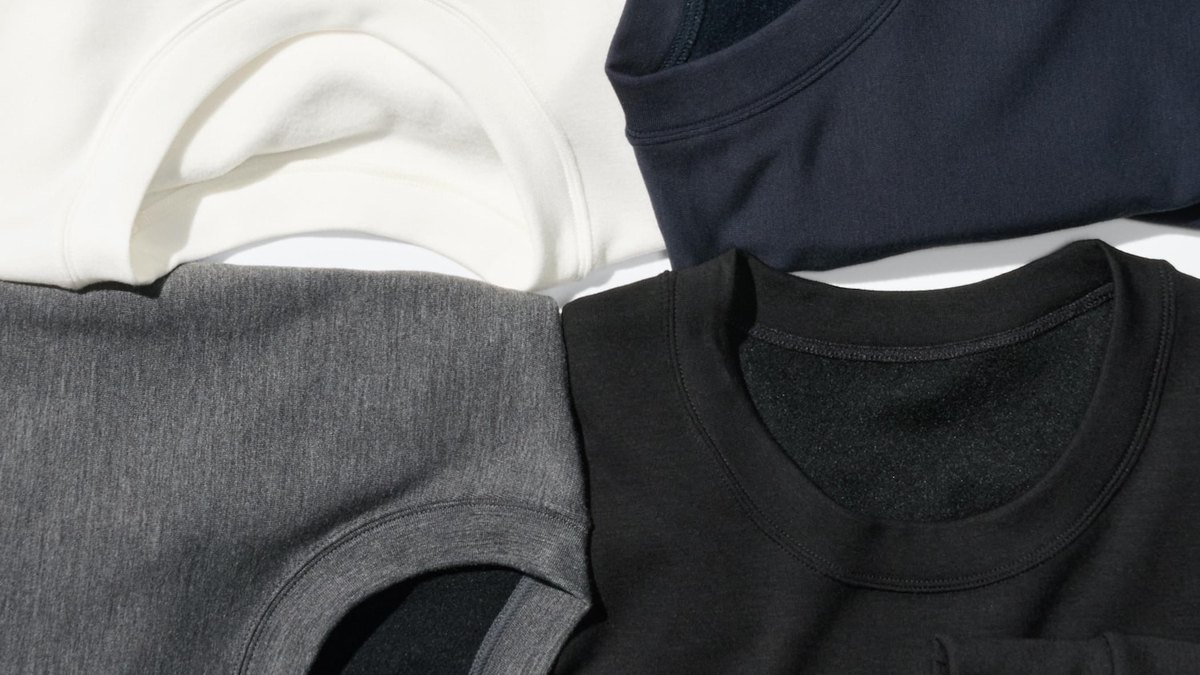
Regular HEATTECH is thin and light and meant to go under everything. Uniqlo works a plant-based oil into the fine fibre so the fabric feels smooth, and treats it to be antibacterial so it doesn't hold on to sweat odour.
This winter the Japanese catalog has Extra Warm in two versions. The basic models both cost ¥2,490 and are rated equally warm. On the cotton one, the side against your skin is knitted from 100% cotton, which suits anyone who doesn't like synthetics next to the body. The cashmere blend is thinner and slightly sheer. Uniqlo suggests wearing it under a sweater or on its own as a sheer top. It goes in the washing machine turned inside out, in a laundry net.
Ultra Warm has the thickest, longest brushing on the inside. Uniqlo says this is why it feels warm the moment you put it on. At the 2016 launch Tabata said the easy route would have been a thicker fabric, but that would have made it uncomfortable, so Ultra Warm was kept thin and close-fitting.
For which weather and which day
Under a dress shirt at work, go for regular HEATTECH or Extra Warm with a 9/10 sleeve (9分袖 in the model name). The sleeve is shorter than a shirt sleeve, so the cuff doesn't peek out from under your shirt cuff. With an open collar, a V-neck stays hidden.
For hard frost and long hours outdoors, build a set from Ultra Warm, top and bottom. The men's bottom is called tights (タイツ) in Japan, what most of us call long johns, and many models have a fly. The women's bottom is leggings (レギンス). Ultra Warm launched as exactly that kind of set in 2016: men's and women's tops, men's tights and women's leggings.
Some models work as a single layer, without a sweater on top. The women's Ultra Warm crew neck has a neckline designed to be worn on its own. The women's cotton Extra Warm with a ribbed neck looks like an ordinary T-shirt. Uniqlo pitches the men's Ultra Warm as both underwear and loungewear.
Kids' sizes go by height, from 100 to 160 cm. Kids' HEATTECH uses its own fabric, softer than the adult one, and in 2025 Uniqlo updated it for kids' Extra Warm and Ultra Warm. A regular kids' top is ¥990, Extra Warm ¥1,290, Ultra Warm ¥1,990. Kids' Ultra Warm is substantial enough to wear as an everyday long-sleeve top. Regular kids' HEATTECH also dries quickly, so a child isn't left cold in a damp vest after running around; Uniqlo says plainly that kids' Extra Warm and Ultra Warm don't have that feature. The label on regular kids' underwear now has a space for a name, handy for daycare and school. For babies there is a cotton long-sleeve top at ¥990.
Colder than −20 °C (−4 °F)
Uniqlo's official range for Ultra Warm ends at −20 °C (−4 °F), and Uniqlo says nothing about colder weather. Winters on the Canadian prairies, in northern Scandinavia, in Minnesota or North Dakota and in Siberia can drop to −35 or −40 °C (−31 or −40 °F). HEATTECH still has a job to do in that kind of cold, as the base layer under everything else. That is our advice from how layering works, not a rating from Uniqlo.
Cold-weather clothing is built in three layers. The base layer sits against the skin, keeps warmth there and moves moisture away so you don't end up damp. That is HEATTECH's job. The mid layer insulates: a fleece or a wool sweater. The outer layer keeps out wind and snow, a down jacket or a parka. Without it, the wind strips the heat out of everything underneath. Each layer works by trapping air, so the layers shouldn't squash each other: if your down jacket is tight over your sweater, there's no air left between them and you get colder.
Roughly:
- at −10 °C (14 °F), Extra Warm, a sweater or fleece and a down jacket are enough;
- at −25 °C (−13 °F), you want Ultra Warm top and bottom, a fleece or wool sweater, a warm down jacket, a hat and gloves;
- at −40 °C (−40 °F), Ultra Warm top and bottom, a fleece with a wool sweater over it, a long hooded down parka, mittens, a scarf and insulated boots.
Uniqlo fleece jackets and down parkas are in the Japanese catalog too; a few of them are in the list below.
What else the Japanese catalog has
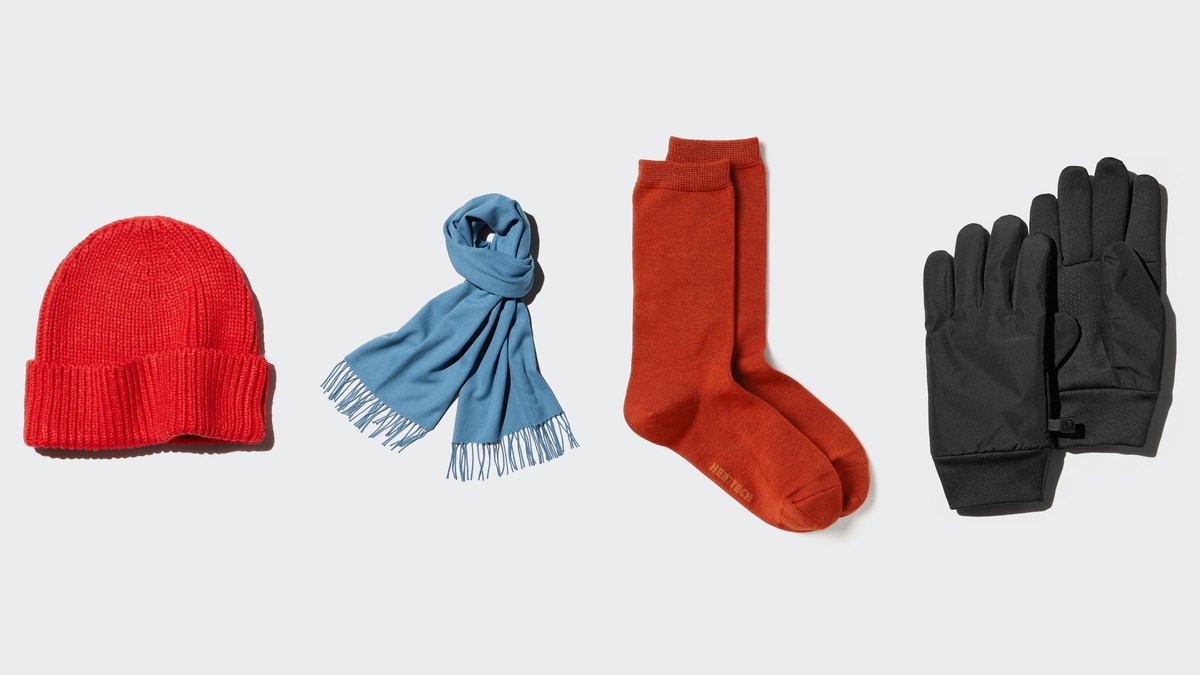
This winter HEATTECH in Japan goes well beyond underwear. There are socks, men's gloves with fingertips that work on a phone screen, beanies and a scarf in acrylic and wool. For women there are tights, warm shorts to wear under a skirt or trousers, a bra tank top and brushed leggings-style trousers. There is even a blanket and a mattress pad. All of it is in the list below with prices.
One piece stands apart: the women's Ultra Light turtleneck at ¥1,290. Uniqlo released it in 2023 as the thinnest HEATTECH ever made, about 20% lighter than regular women's HEATTECH and just as warm.
Size
Men's HEATTECH runs from XS to 4XL, women's from XS to 3XL. A base layer only works when it sits close to the body, so pick your size from the size chart and don't size up. Japanese sizing runs smaller than European and North American sizing: compare the garment measurements on the product page with a top you already own.
To check the level on a product page, go by the Japanese name. If it starts with 超極暖, it's Ultra Warm. 極暖 without 超 in front is Extra Warm. ヒートテック on its own is regular HEATTECH.
Care
Japanese product pages all say the same thing: machine wash in a laundry net, no dry cleaning, no tumble dryer. Dark colours can bleed, so wash them separately. Uniqlo says the knit keeps its shape through repeated washing.
FAQ
Extra Warm or Ultra Warm for −20 °C (−4 °F)? Ultra Warm. It's the only level whose range goes down to −20 °C; Extra Warm stops at −5 °C (23 °F). Either way it goes under a warm jacket, not instead of one.
Will HEATTECH work at −40? As a base layer, yes. On top you need a fleece or wool sweater and a hooded down parka. Uniqlo's own range only goes down to −20 °C (−4 °F).
Can I wear HEATTECH as a top on its own? Some models, and Uniqlo says so: the women's Ultra Warm crew neck, the women's cotton Extra Warm with a ribbed neck and the cashmere-blend Extra Warm. Regular men's HEATTECH is designed as a base layer.
Does HEATTECH shrink? Uniqlo doesn't publish shrinkage figures. It says the knit holds its shape through many washes and rules out the tumble dryer. Wash in a net and dry on a rack.
Is the cotton Extra Warm warmer than the cashmere one? No. Uniqlo rates both at about 1.5 times warmer than regular HEATTECH. The cotton one feels nicer against the skin; the cashmere one is thinner and looks dressier.
The full line-up in our catalog
Japanese store prices, in yen. Choose size and colour on the product page.
Women
Regular HEATTECH:
- Crew-neck long-sleeve top · ¥1,290
- U-neck top, 8/10 sleeve · ¥1,290
- Ultra Light turtleneck · ¥1,290
- Leggings · ¥1,290
Extra Warm (極暖):
- Cotton crew-neck long-sleeve top · ¥2,490
- Cotton U-neck top, 8/10 sleeve · ¥2,490
- Cotton leggings · ¥2,490
- Cashmere-blend crew-neck top · ¥2,490
- Cashmere-blend U-neck top · ¥2,490
- Cashmere-blend turtleneck · ¥2,490
- Cashmere-blend leggings · ¥2,490
- Pile-lined tights · ¥1,500
Ultra Warm (超極暖):
- Crew-neck long-sleeve top · ¥2,990
- High-neck long-sleeve top · ¥2,990
- Leggings · ¥2,990
Men
Regular HEATTECH:
- Crew-neck long-sleeve top · ¥1,290
- Crew-neck top, 9/10 sleeve · ¥1,290
- V-neck long-sleeve top · ¥1,290
- V-neck top, 9/10 sleeve · ¥1,290
- Tights with fly · ¥1,290
Extra Warm (極暖):
- Cotton crew-neck long-sleeve top · ¥2,490
- Cotton crew-neck top, 9/10 sleeve · ¥2,490
- Cotton V-neck long-sleeve top · ¥2,490
- Cotton V-neck top, 9/10 sleeve · ¥2,490
- Cotton tights with fly · ¥2,490
- Cashmere-blend crew-neck top, 9/10 sleeve · ¥2,490
- Cashmere-blend turtleneck, 9/10 sleeve · ¥2,490
- Cashmere-blend tights · ¥2,490
Ultra Warm (超極暖):
- Crew-neck long-sleeve top · ¥2,990
- Tights with fly · ¥2,990
Kids
Regular HEATTECH:
- U-neck T-shirt, short sleeve · ¥990
- U-neck top, 9/10 sleeve · ¥990
- Tights · ¥990
Extra Warm (極暖):
- Cotton long-sleeve top · ¥1,290
- Cotton tights · ¥1,290
- Girls' pile-lined leggings · ¥1,290
Ultra Warm (超極暖):
- Long-sleeve top · ¥1,990
- Tights · ¥1,990
Babies:
Socks, gloves and home
- Women's socks · ¥590
- Men's socks · ¥590
- Kids' socks, two pairs · ¥790
- Men's gloves, touchscreen fingertips · ¥1,990
- Ribbed beanie · ¥1,500
- Scarf, acrylic and wool · ¥1,990
- Women's knit tights · ¥1,500
- Women's compression tights · ¥1,500
- Women's warm shorts for under a skirt or trousers · ¥1,290
- Bra tank top · ¥2,490
- Women's brushed leggings trousers · ¥3,990
- Blanket: single · ¥5,990, double · ¥6,990
- Mattress pad: single · ¥5,990, double · ¥6,990
Mid and outer layers
- Men's fleece jacket · ¥2,990
- Women's fluffy fleece full-zip jacket · ¥2,990
- Men's seamless down parka · ¥14,900
- Women's seamless down parka · ¥14,900
For every colour and the models not listed here, search the catalog for HEATTECH.
How to order
Uniqlo's Japanese online store doesn't ship abroad, so people outside Japan buy from it through a proxy service. Our site carries the Japanese Uniqlo catalog at Japanese prices, in yen. You pick the size and colour on the product page and pay on our site, and we buy the item from Uniqlo Japan. Shipping depends on the parcel's weight and your city: the delivery calculator gives an estimate, and we tell you the exact cost once the parcel is weighed.
Update history
- 2026-11-16 — article published.